
Finding People in the Brea Residents Directory
Start any Brea residents directory search with a precise question. Ownership, current registration, a past household, a court appearance, and a family event. Those are five different questions. The Orange County Assessor and GIS tie a street address to a parcel. The Clerk-Recorder ties a person to a recorded instrument. The county voter tool lets a person check their own record. It is not a way to browse a street. Court and vital records carry their own limits. Older household clues may wait in a directory or the Brea Museum archive.
Treat a first result as a lead, never a conclusion. A parcel owner may get tax notices at a different address. A court party may simply share a name with someone in Brea. Directory entries usually name an adult or householder, not everyone under the roof. The strongest trail pairs two anchors. Think of an APN with a legal description, a spouse with an address, or a case role with a date.
- State the goal: current ownership, a public official, a historical household, an heir, or a record of an event.
- Start with the source that matches the clue. Use the Assessor or GIS for an address, the court portal for a case, and a directory for a past year.
- Write down the exact spelling, dates, APN, case number, instrument number, or volume reference returned by the first source.
- Confirm the clue in a second official or archival source, keeping owner, mailing, and occupant evidence separate.
- Ask the custodian for a copy or correction when the index is not enough, rather than treating a compiled result as proof.
That sequence keeps a Brea residents directory search honest. It yields leads without pretending to be a census of any private household in Brea.
Where Brea Resident Records Live
Brea records sit in a city desk, county land offices, the courts, and state programs. The Brea City Clerk keeps municipal records, rosters, campaign filings, ordinances, minutes, and the city Record Library. Orange County adds the parcel, deed, tax, marriage, and court layers. California offices handle vital records, licenses, business filings, and confidentiality programs. No single office answers as much as a full residents directory would. Each lookup starts by choosing the right shelf.
Orange County Clerk-Recorder
601 N. Ross Street
Santa Ana, CA 92701
(714) 834-2500
Orange County Registrar of Voters
1300 S. Grand Avenue, Building C
Santa Ana, CA 92705
Use published county contact
The city clerk also accepts non-police and non-fire public-records requests. The county recorder, by contrast, will not run a name search for a requester. That difference shapes both the time and the cost of a Brea lookup.
The Brea City Clerk page is the municipal starting point. It names the office that holds city records. It also points a requester toward the current records route.
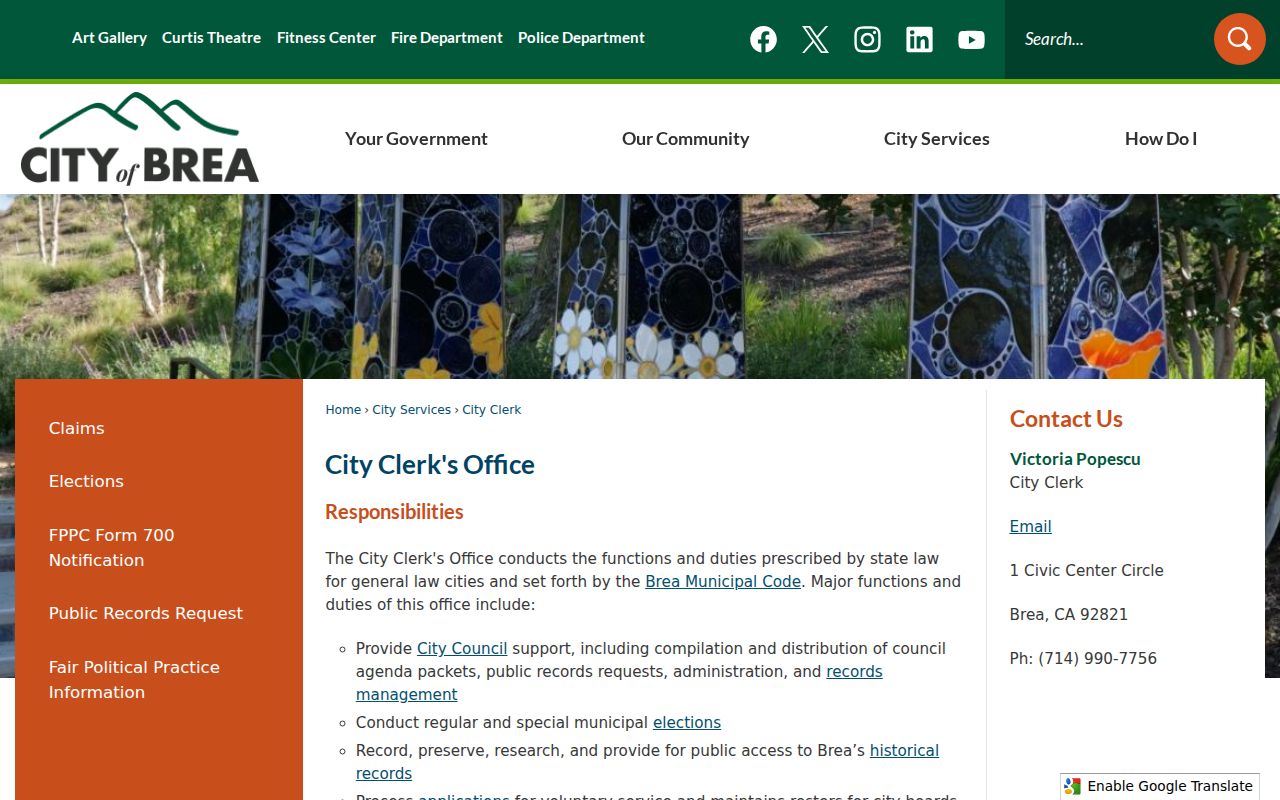
The City Clerk image above is an office-level reference, not a household roster. Cite the department name and record description when requesting a city-held file.
From a Brea Address to Its Parcel
An address is the best opening clue for many Brea records. But not every office keys on it. Begin with the Orange County Assessor property-information gateway and the county map. Enter the situs address or APN. Then record the parcel number, tract or legal description, and any mailing destination shown. The situs is where the land sits. The mailing address is where the county sends notices. Neither field amounts to a resident list.
Use the OC Public Works Interactive Map to check the parcel shape. It also shows the lots nearby. A popup can show the APN, geometry, jurisdiction, and map context. Zoning, flood, district, and aerial layers add geography. None of them shows who occupies a home. The APN then becomes the bridge to permits, tax records, and the recorder's name index.
The Assessor gateway points toward ParcelQuest and warns that web fields can change. For a critical ownership question, compare the online result with counter information at 500 S. Main Street. The parcel map itself describes boundaries and dimensions. The assessment card may show characteristics, values, transfer information, and mailing administration where displayed.
Read the official parcel-map explanation before treating a map line as a legal boundary. A parcel identifies land. It does not prove that every person in a Brea household lives there. And it cannot replace the recorded deed.
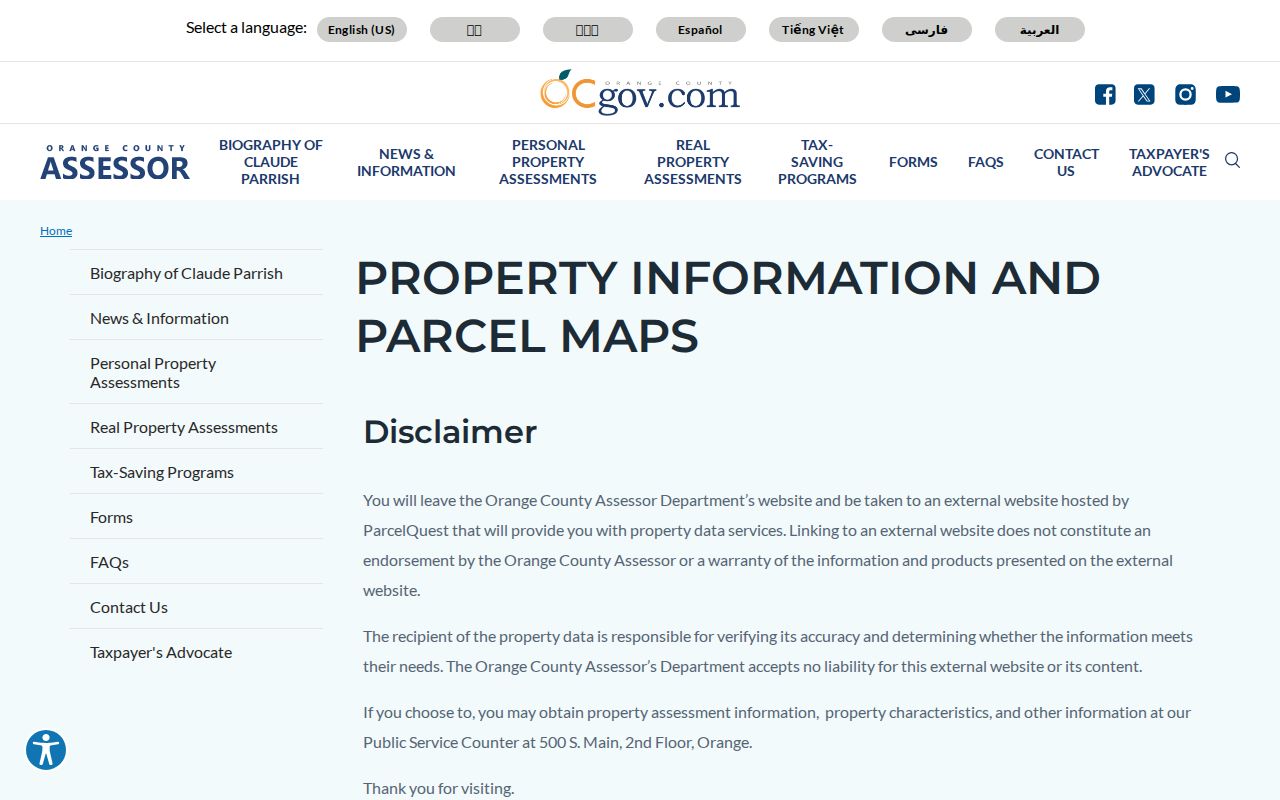
The assessor gateway shown above is the practical first stop for turning a Brea street clue into a parcel record. Carry the APN into every later search. Keep the situs and mailing fields in separate notes.
- Parcel
- A mapped piece of land identified by the county with an APN.
- Situs address
- The physical location of the parcel, distinct from the notice or mailing address.
- Legal description
- The tract, lot, or other land wording that helps match a deed to the correct property.
- Index
- A finding aid that points to a record; it is not the full recorded instrument.
Brea Recorder Search Is an Index
The Orange County Clerk-Recorder's Grantor-Grantee Index searches parties to recorded instruments, not street addresses. The name path takes grantor or grantee. You can also enter a last or business name, an optional first name, recording dates, and a document type. Try name variants, and reverse the party role when tracing a deed. A lender, trustee, or lien claimant can appear beside the people tied to ownership. So a Brea deed search reads best as an index of parties rather than a roster of homes.
- Search mode
- Grantor or grantee party name.
- Name fields
- Last or business name on the name path; first name is optional.
- Date fields
- Optional start and end recording dates.
- Document types
- Deeds, deeds of trust, liens, releases, reconveyances, and other recorded types.
- Result fields
- Party names, document type, recording date, and instrument number; older references may include book and page.
The Brea recorder's web product is an index only. It shows no images. Staff will not run searches by phone, mail, or at the counter. To request a pre-1982 copy, bring the book, page, and instrument references when you have them. Records from 1982 forward work differently. The reference is the recording year plus a six-digit instrument number. Copies run $1 per page. Certification adds another $1 for any document or map under the current county schedule.
The county's official copy instructions describe what to do after an index hit. The free Grantor-Grantee Index is the image-linked finding aid displayed below.
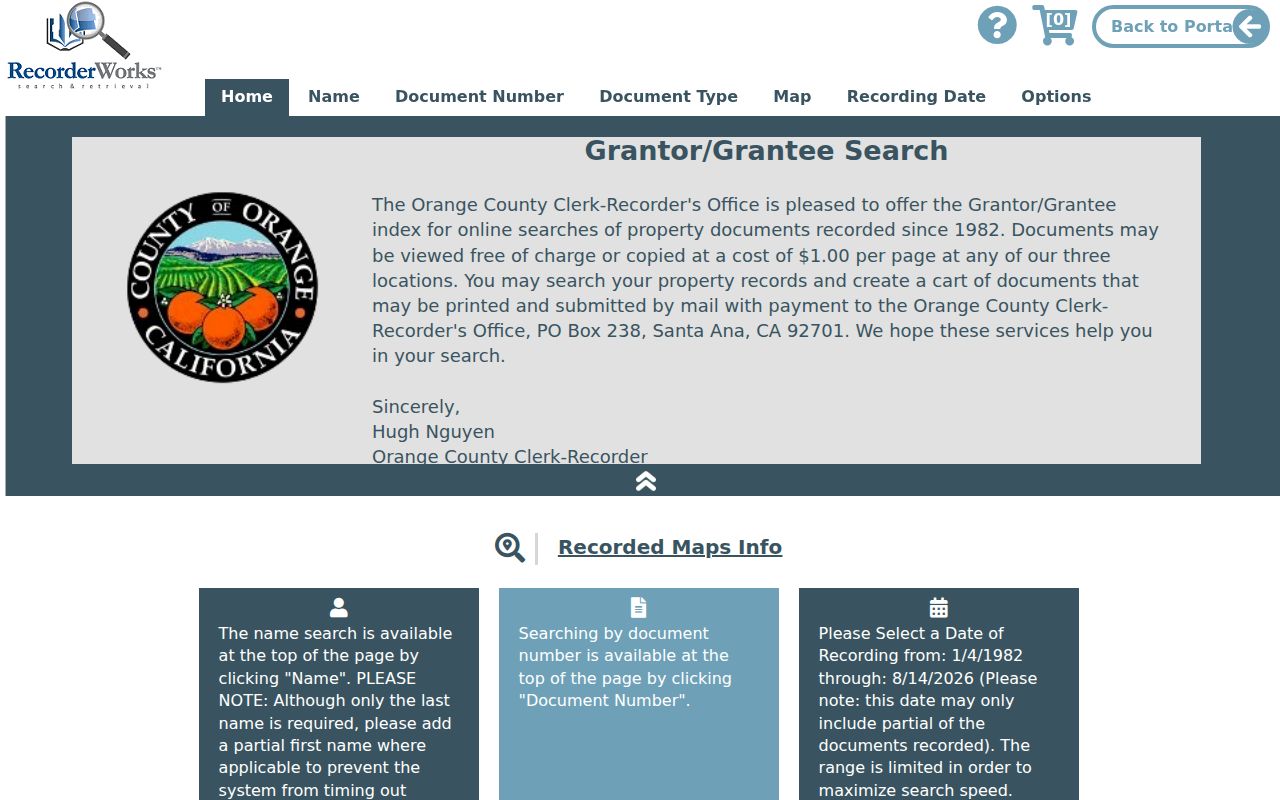
The Grantor-Grantee Index image above shows the first step in any Brea residents directory search. The free index lists instruments with their reference numbers. Save that reference before requesting a deed, because the index is the map and the deed itself is the paid or in-person record.
Useful local check. Orange County's title-recording courtesy notice is automatic and free. A notice is a prompt to inspect the index, not proof that a document is fraudulent or that a person lives at the property.
Today's Brea Resident Records
Modern directory-like sources each answer a different slice of the question of who is connected to Brea. The property roll covers land and assessment. The voter tool is a private self-check, while city records name officials, applicants, and meeting participants acting in public roles. A permit can identify an applicant or contractor. No single source serves as a universal household roster.
| Source | What It Can Show | Keeper | Access |
|---|---|---|---|
| Property information | APN, situs, assessment, characteristics, mailing administration | Orange County Assessor | ParcelQuest gateway and counter |
| Recorded index | Parties, dates, instrument type, ownership trail clues | Clerk-Recorder | Free index, paid copies |
| Voter self-lookup | One person's status, address, districts, ballot and participation history | Registrar of Voters | Identity-gated self service |
| City Record Library | Officials, applicants, filings, agendas, contracts, permits and notices | Brea City Clerk | Free browse/search; CPRA fallback |
| Official license or entity record | Work role, business affiliation, license status, address of record | California agencies | Free official portals |
A Brea residents directory works best when the source fits the question. Match the record to the need. An entity or license file confirms a public affiliation, not a home address. The city library or Museum can test a historic clue, though an old newspaper mention should never be read as current. Turn to the county office when a record must be corrected or certified.
Brea Voter Lookup Is Identity-Gated
The Orange County Voter Lookup Tool is a self-verification service. Its documented Verify path asks for a date of birth plus the last four digits of a driver's license. It can then return registration status, a current address, polling place, districts, elected officials, vote-by-mail or ballot status, and participation history. An address mode helps a person find a polling place by street number and street name. That mode is not a public name search.
California restricts the full voter file under Elections Code sections 2188, 2194, and 18109, Government Code section 7924.000, and Title 2 regulations sections 19001 through 19013. An approved applicant must state a permitted election, scholarly, journalistic, governmental, or political purpose. The applicant also identifies the requested geography and fields, signs a use and security agreement, provides identification, and pays before pickup or shipping. Email and fax applications are not accepted under the county's posted process.
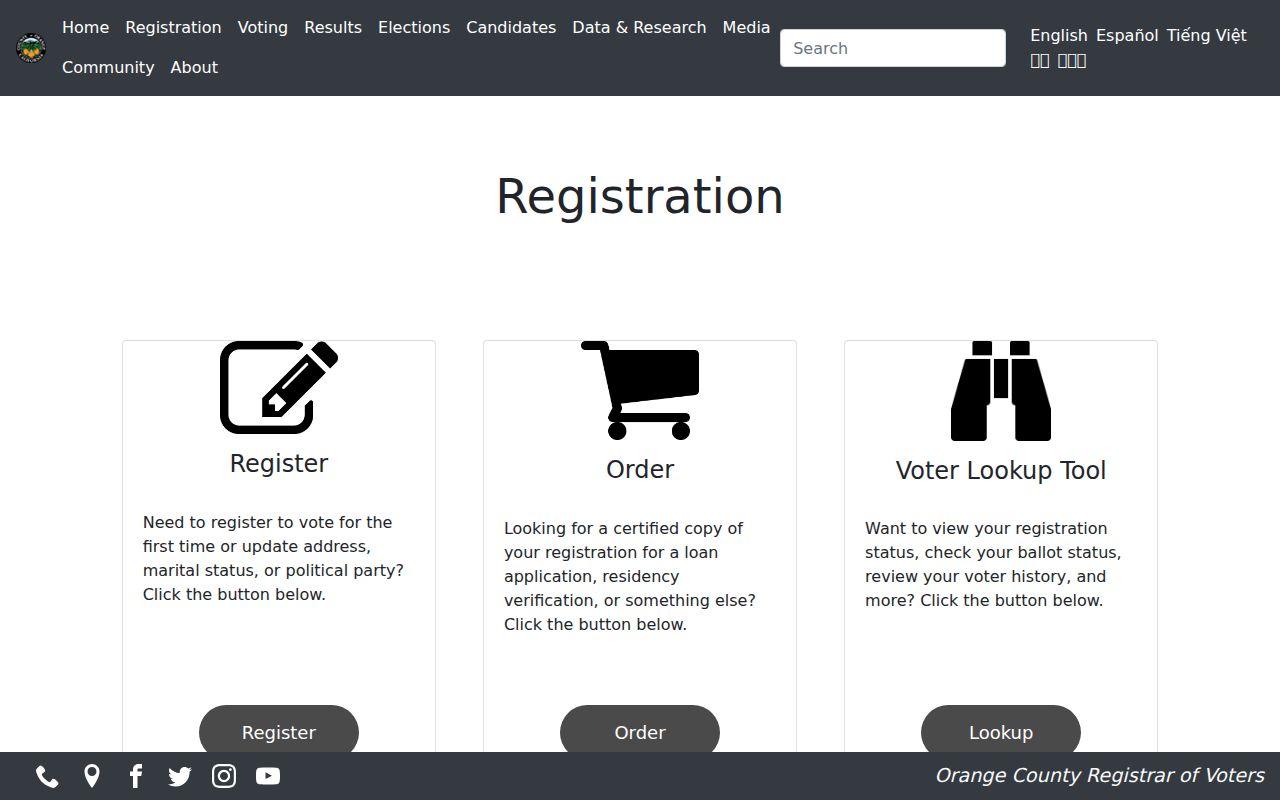
The lookup screen above shows registration status, not a Brea residents directory. It confirms your own enrollment and whether a ballot was credited. How anyone voted stays private. Safe at Home participants are suppressed entirely. That silence protects them rather than hinting at a move.
So a street-level voter roll goes only to qualified recipients through an approved product. Nobody should try to rebuild one from casual guesses.
Orange County Court Search in Brea
The Orange County Superior Court Case Access page splits its routes by case type. Civil, criminal and traffic, family, probate, and small claims each get their own path. Names drive the search. A case number works too when you already have one. Results may include party names and roles, filing date, case type, courthouse, status, future events, and register-of-actions entries when the court posts them.
Orange County reports searchable court records back to 1889. Current indexes sit online. Older ones stay at the relevant justice center. North Justice Center at 1275 N. Berkeley Avenue in Fullerton handles many northern-county matters, though the case designation governs. Aged files can rest off-site and need several days. To view a non-imaged file, deposit a valid photo ID with the clerk.
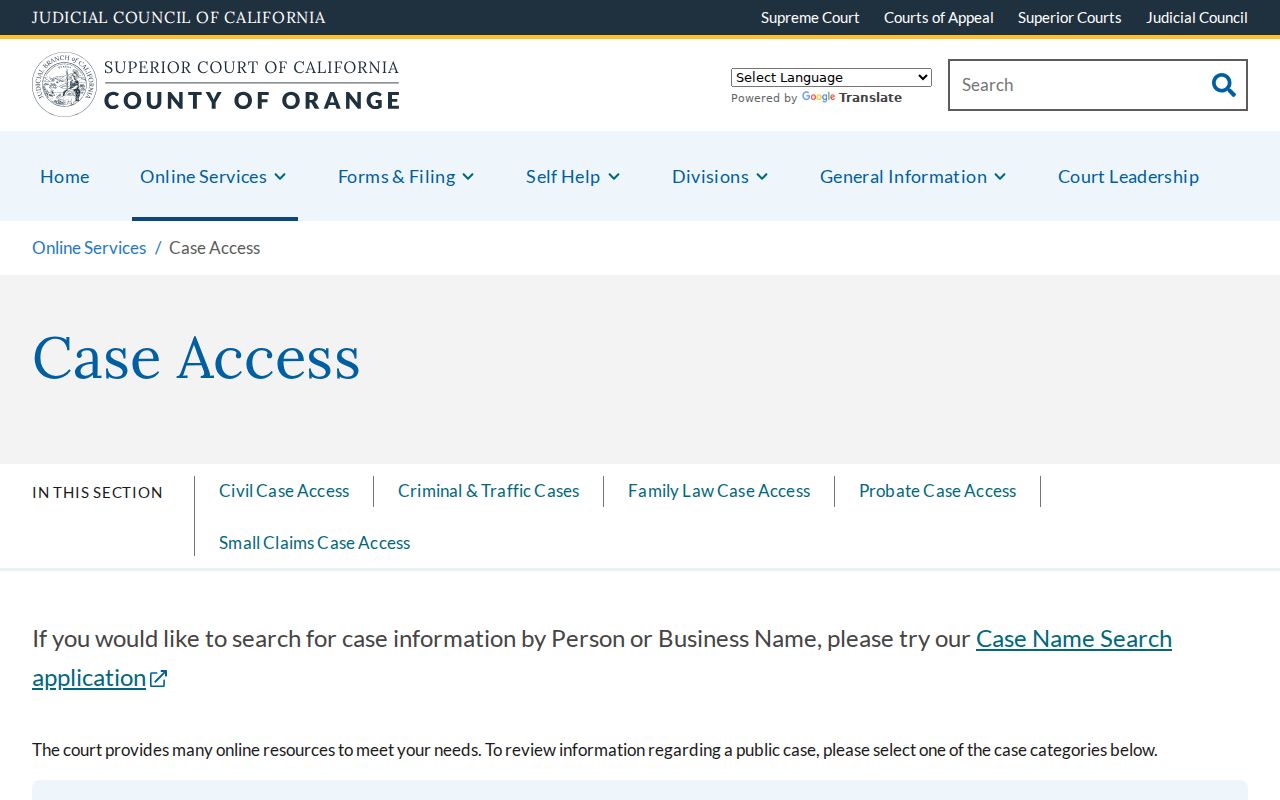
The access choices above help you tell a party index apart from the real file. Adoption, juvenile, sealed, and other restricted matters stay closed. A name search surfacing them changes nothing. For a criminal search by mail, Form L-3009 does the job. Send it with a check and a self-addressed stamped envelope. Include a stated name, date of birth, and violation detail where known. The court quotes seven to ten working days for that route.
When a result matters, record the case number and party role. Then ask the court for the permitted file or copy. A shared name alone cannot merge two different people.
Brea Vital Records: Informational or Authorized
Two offices matter for a Brea vital record. They are the Orange County Clerk-Recorder and the California Department of Public Health. California splits certified copies into two kinds. An informational copy is open to almost anyone. It covers most nonconfidential birth, death, and public-marriage records. An authorized copy demands an eligible relationship or legal category. It also requires a sworn statement and usually a notarized mailed application. Confidential marriage records go only to a spouse. Otherwise they are released by court order under Family Code section 509.
- Birth and death
- Orange County or CDPH; authorized categories apply to identity-use copies, while informational copies may be available.
- Public marriage
- Orange County or CDPH; public and confidential marriage paths differ.
- Confidential marriage
- County of issuance; a spouse or court order is required under Family Code section 509.
- Divorce
- The Superior Court supplies the decree; CDPH supplies a certificate or summary for maintained years.
- 2026 state fees
- CDPH lists $31 birth, $26 death, $19 marriage, and $18 dissolution certificate fees.
A CDPH application gathers the applicant and the event. It also asks for names, dates, place, relationship, purpose, copy type, a signature, and payment. No vital record is released until all of that is complete. One rule trips up many first-time requesters. Choose the custodian by the county where the event happened. That county may differ from where the person lives now. A no-record certificate still costs the search fee, so precision up front saves money. For older entries, the California State Archives and FamilySearch add historical indexes. Image access and Brea coverage vary, though.
Brea Mailing Address and Residence
A mailing address answers a narrow question in any Brea residents directory search. It shows where an assessment notice or similar mail gets sent. Nothing more. The situs, by contrast, identifies the parcel itself. An owner can live elsewhere and mail elsewhere still. A company or agent may receive notices on the owner's behalf. Keep one more caution in mind. A displayed owner name reveals nothing about renters, children, guests, or anyone else sharing the household.
| Clue | Best question answered | What it cannot prove |
|---|---|---|
| Situs | Where the land and parcel are located | Who is inside the building today |
| Mailing destination | Where tax or assessment notices go | Owner occupancy or present residence |
| Deed party | Who signed or received a recorded instrument | Continuous ownership or occupancy without chain review |
| Directory entry | Named adult or householder at a printed date | Every member of the household or a current address |
This distinction keeps official rolls and commercial compilations in their proper places. A compiled report can go stale or blur two people who share a name. A county record is different. It carries a custodian, a filing date, and a defined field. Read the field for exactly what it states. Then stop short of any broader claim about who lives there.
Older Brea Resident Directory Sources
The National Archives' Orange County collection holds the city directory volumes with the most specific verified evidence. Countywide books include Brea for 1926 and 1929. A 1931 volume lists Brea as well. There is no Brea-only series. So a spine may read Orange County. Even so, the Brea entry may be precisely the local clue you need. For catalog and database help, the Brea Library is the place to start. The Brea Museum complements it with local newspapers, photographs, city documents, manuscripts, and ephemera.
What a printed directory can tell you is considerable. It may name an adult, an occupation, sometimes a spouse, and a residence address. Abbreviations carry weight. "h" often marks a householder or home. "r" marks a resident or roomer. "wid" marks a widow. A reverse, or criss-cross, section can arrange names by street and number instead. The official NARA catalog does not settle the reverse section or publisher for every volume, though. Read the title page and the abbreviation key before treating any mark as fact.
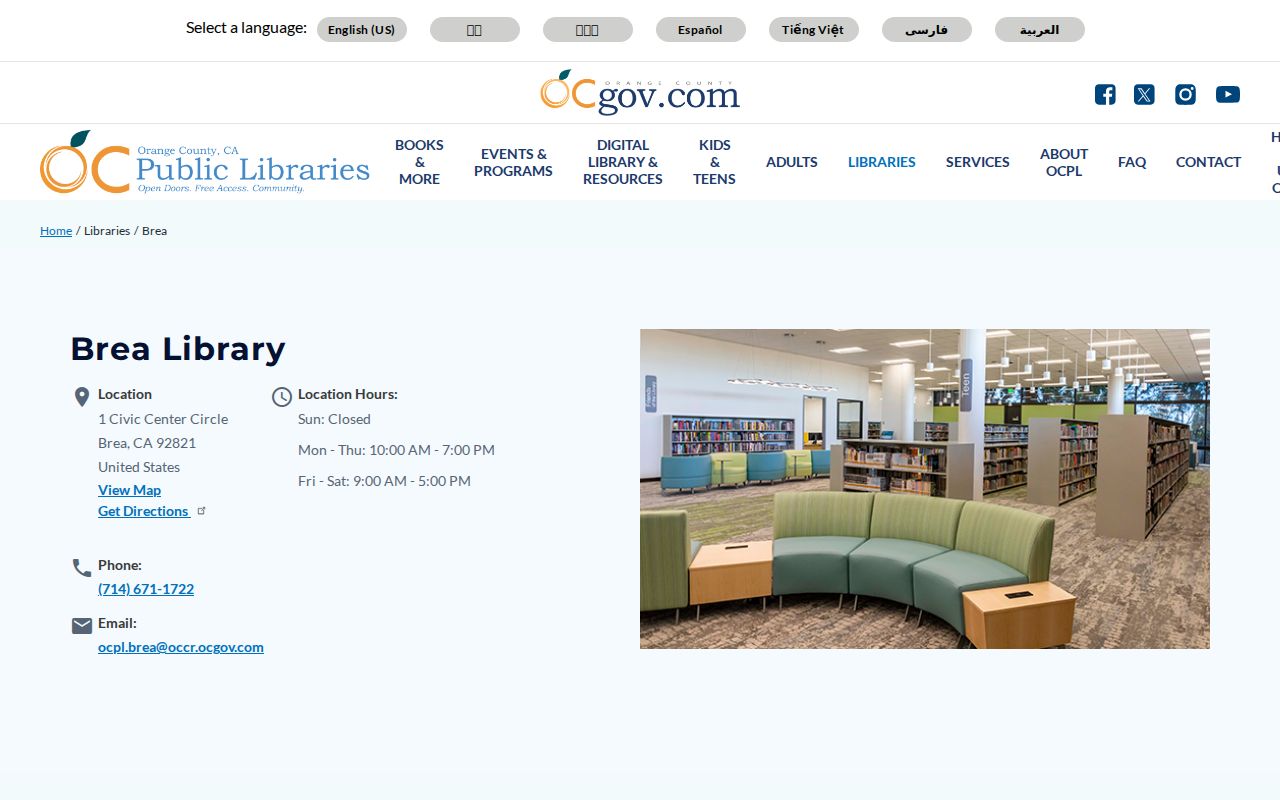
The Brea Library remains the practical place to confirm current branch services and catalog access. It publishes no itemized list of Brea directories, obituaries, or microfilm. Ask staff to verify the exact shelf or licensed database before you visit.
Brea's Oil-Town Resident Trail
Brea takes its name from the Spanish word for tar. Oil shaped its early years around the Olinda field. That history matters for a residents directory search. An early resident may be listed under Olinda, an oil camp, unincorporated Orange County, or a neighboring town. The entry may not sit under Brea itself. Orange County formed in 1889, and Brea incorporated in 1917. Those two dates give clean catalog boundaries for any street directory or resident lookup.
The Brea Museum research collection anchors this trail. It holds more than 45,000 objects and records. These include rare photographs, newspapers, manuscripts, city papers, oral histories, and vertical files. Such material often explains a nickname or camp label that a county index skips. Treat oral history as a lead only. Check it against a deed, census page, city directory, or another official record. Only then rely on it.
When Brea Records Leave the Web
A missing online record is not a missing record. The Brea City Clerk public-records form asks for your contact details, the department you believe holds the record, a description and date range, whether you want inspection or copies, delivery preference, and a signature. The City normally gives a determination within ten days. Production can take longer. Police and fire records follow separate routes.
The City Clerk's Record Library offers browse and keyword modes for agendas, contracts, budgets, campaign statements, boards, minutes, ordinances, public notices, resolutions, staff reports, and Statements of Economic Interests. New agenda software covers meetings from October 19, 2023 forward. Earlier material sits in archived minutes, the Record Library, or a CPRA request.
For local history, the Brea Museum at 125 W. Elm Street, (714) 256-2283, keeps research hours on Thursday from 2 to 5 and Saturday from 10 to 3. Brea Library, at 1 Civic Center Circle, is open Monday through Thursday 10 to 7 and Friday through Saturday 9 to 5. Once you have an index reference, the county recorder can supply copies. These fallbacks fill the gaps a search box cannot.
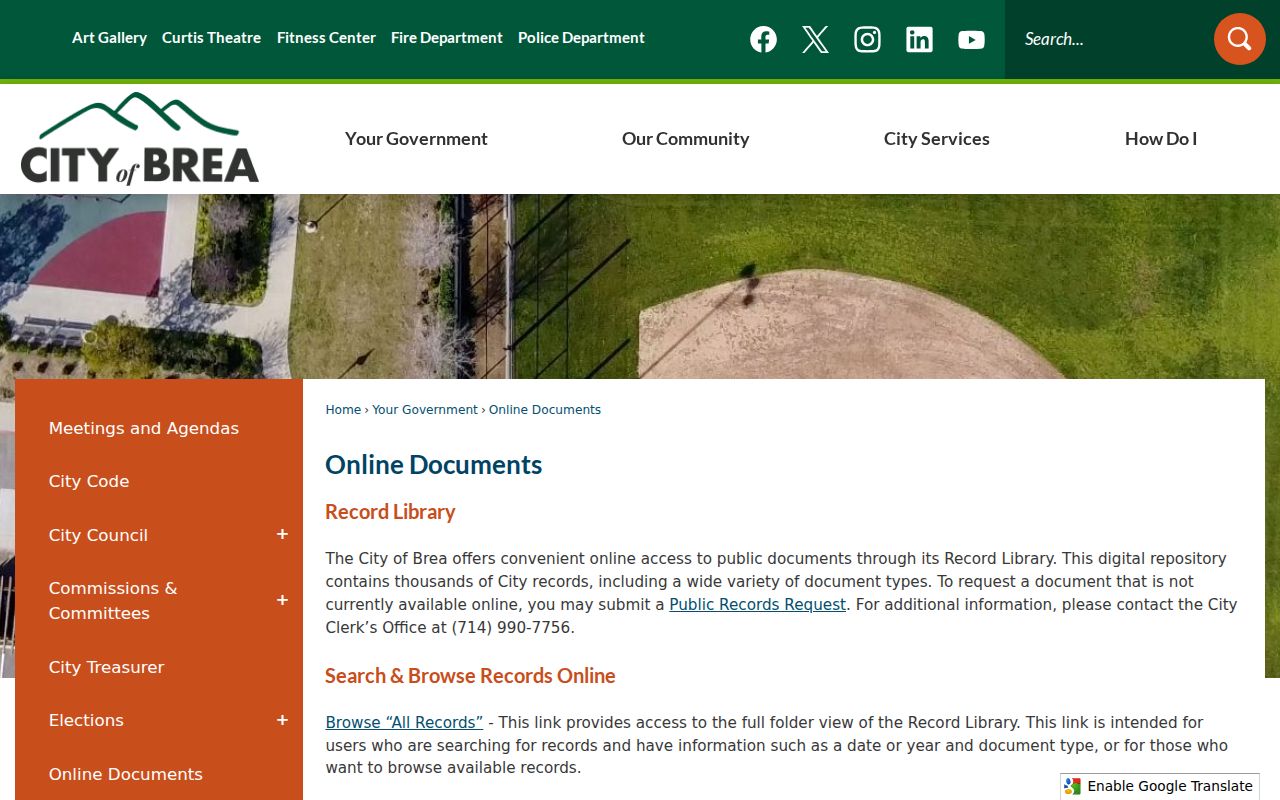
The Record Library image above points to the city's own browse and search collection. Describe one record or date range at a time, so the custodian can find an existing file rather than create a new directory entry.
Brea Searches for Heirs, Classmates, and Businesses
A Brea residents directory search gets sharper once you name the purpose. For an heir, start with Orange County probate case access by decedent or party. Then read public petitions, notices, and distribution entries. A deed tied to the estate gives a second anchor. For a classmate, ask the Museum, Brea Library, school archives, or a reunion group about yearbooks and alumni files. Then match a later surname against an official marriage, business, or license record.
Business owners and public professionals call for official registries. Try California Secretary of State bizfile, the Orange County fictitious-business-name search, a state license board, and a Brea permit. An entity result can show legal name, status, formation date, addresses, agent, and Statements of Information. A license result may list status, issue and expiration dates, address of record, and public discipline. Remember that an agent or mailing address is a business clue, not proof of a home.
The same-name rule still governs any resident lookup. Keep two independent anchors before joining records. Send errors to the custodian who created the field. The Assessor manages assessment and mailing data. The Registrar handles a person's own voter record. The court keeps its docket, and the Recorder runs the index and recorded instrument process.
Privacy Boundaries for a Brea Residents Directory
Not every name belongs in a public Brea residents directory. Some gaps are deliberate. California runs a Safe at Home program for qualifying survivors and other protected participants. It gives them a substitute mailing address along with confidential voter enrollment. Voter rolls also carry use restrictions, since approved purposes govern who may pull them. DMV records sit under the federal Driver's Privacy Protection Act. Utility-customer lists are not a public street roll either.
The California Public Records Act, Government Code sections 7920.000 and following, covers requests for identifiable records. Those records must be ones an agency already holds. It does not force an office to build a fresh household list. Nor must it answer an investigative question. Court files, vital records, adoption papers, juvenile matters, sealed cases, and confidential files all follow separate rules. The lawful path is simple: work from a named source for a lawful personal purpose, skip unwanted contact, and confirm what you find with the records office that keeps it.
Personal research limit. Public records can support genealogy, property history, civic research, and reconnection. Do not use a Brea residents directory or any linked roll to stalk, harass, intimidate, or harm another person.
That limit doubles as a quality rule. A good residents directory points to what a record truly proves and flags where the trail runs out. For current street work, turn to the Brea street directory; for older volumes, browse the Brea city directory collections.