
Verified Brea Directory Shelves
The verified Brea city directory evidence is not a single Brea-only shelf. The National Archives catalog identifies Orange County volumes that include Brea, while the Brea Museum preserves local material that can explain the people, businesses, oil camps, and neighborhoods named in those volumes. The table keeps a firm line between verified coverage and a collection that still needs a catalog check.
| Collection | Years | Where Held | Access |
|---|---|---|---|
| Orange County city directories including Brea | 1926, 1929, 1931 | National Archives circa-1930 directory collection | Research access; confirm reel or digitization |
| Brea Museum archive and reference library | Founding era to present; item dates vary | 125 W. Elm Street | Thursday and Saturday research hours; free |
| Museum vertical files and local newspapers | Dates vary by item | Brea Museum and its research service | Ask staff for item-level access |
| Federal population census | 1920 through 1950 for the local trail | NARA and partner databases | Public under the 72-year release rule |
| FamilySearch California county collections | Births and deaths 1800-1994; marriages 1850-1952 | FamilySearch catalog and images | Free account; image limits vary |
The NARA listing is a useful correction to a common catalog mistake. A volume titled Orange County can still contain the needed Brea entry. No official source verified an exhaustive local year run, a Brea-only publisher sequence, or a locally digitized criss-cross volume. Those gaps belong in the research plan rather than being filled with an assumed series.
NARA's Brea Entries by County Volume
The National Archives directory table places Brea beside Anaheim, Fullerton, Placentia, La Habra, and other Orange County communities in the 1926 and 1929 material. A 1931 Orange County volume also lists Brea. The volumes provide a concrete bridge between the 1920, 1930, and 1940 federal censuses. Search the catalog entry at collection level, then confirm the title page, coverage list, publisher, and reel before citing a page.
A countywide book can hold several local labels. Brea's oil history means that Olinda, a company camp, an unincorporated Orange County address, or a nearby place may be the form printed in an older source. Search exact surnames, initials, spouses, and streets. Do not reject a result because the modern city label is missing.
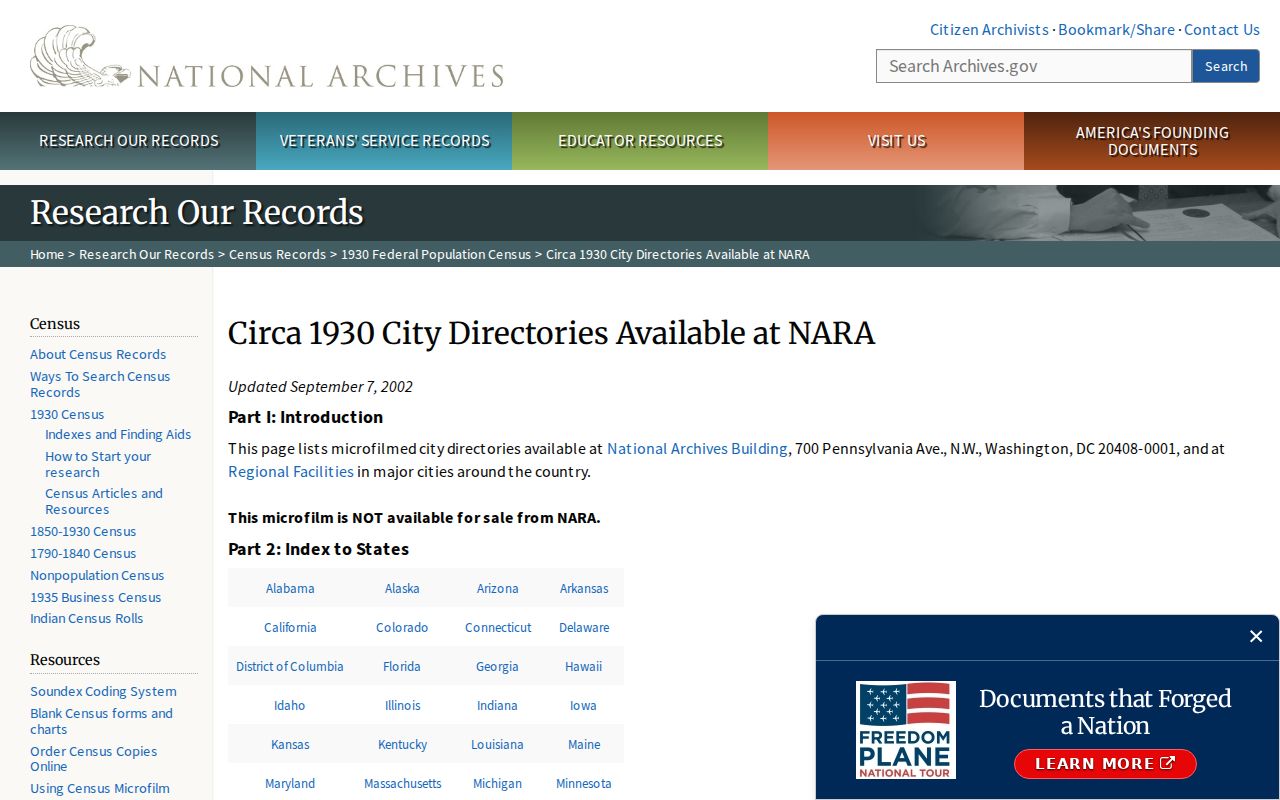
The NARA listing pictured above is the evidence for Brea's inclusion in the county volumes. It does not by itself prove that every year or reverse section is available online, so record the catalog title and then ask the archive about the exact copy.
Inside the Brea Museum Directory Archive
The Brea Museum is the local context layer for a Brea city directory search. The city describes a collection of more than 45,000 objects and records, including photographs, manuscripts, rare images, city documents, newspapers, and ephemera. The Museum's research page also points to vertical files, oral history, Brea City, census, oil, and Orange County subjects. These materials can decode a business name, an oil-camp label, or a house nickname that is too local for a county index.
The Museum is at 125 W. Elm Street, with research hours Thursday from 2 to 5 and Saturday from 10 to 3. The phone is (714) 256-2283. The collection is free to use, but item-level dates and reproduction terms vary. Ask for a finding aid before making a trip, and treat an oral-history statement as a lead to compare with a deed, census, newspaper, or official city paper.
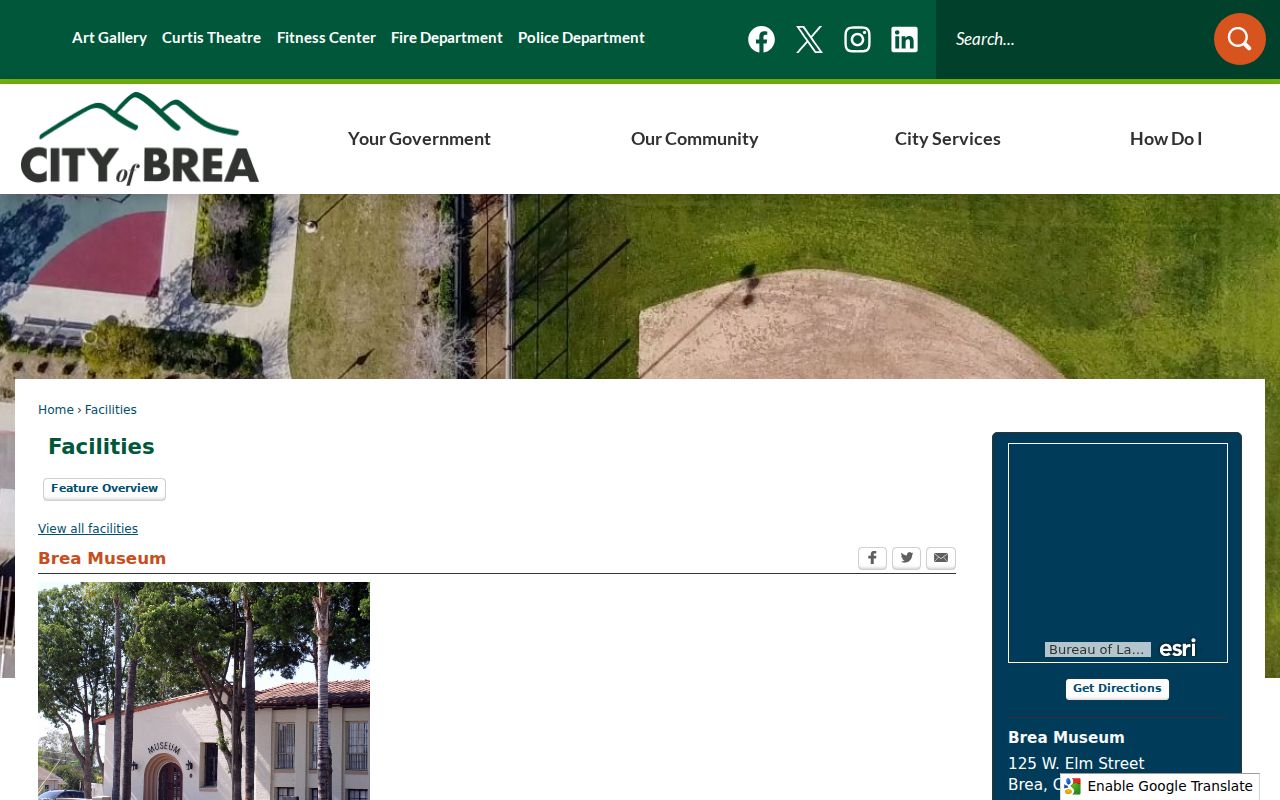
The Museum page shown above gives the current facility and contact setting. A Brea city directory entry becomes much more useful when the Museum can connect it to a photograph, newspaper notice, oil file, or historic-property folder.
The Museum's research collection page adds the archive-facing route for vertical files, oral histories, and local subject folders. It is the source pictured below for research planning beyond the facility page.
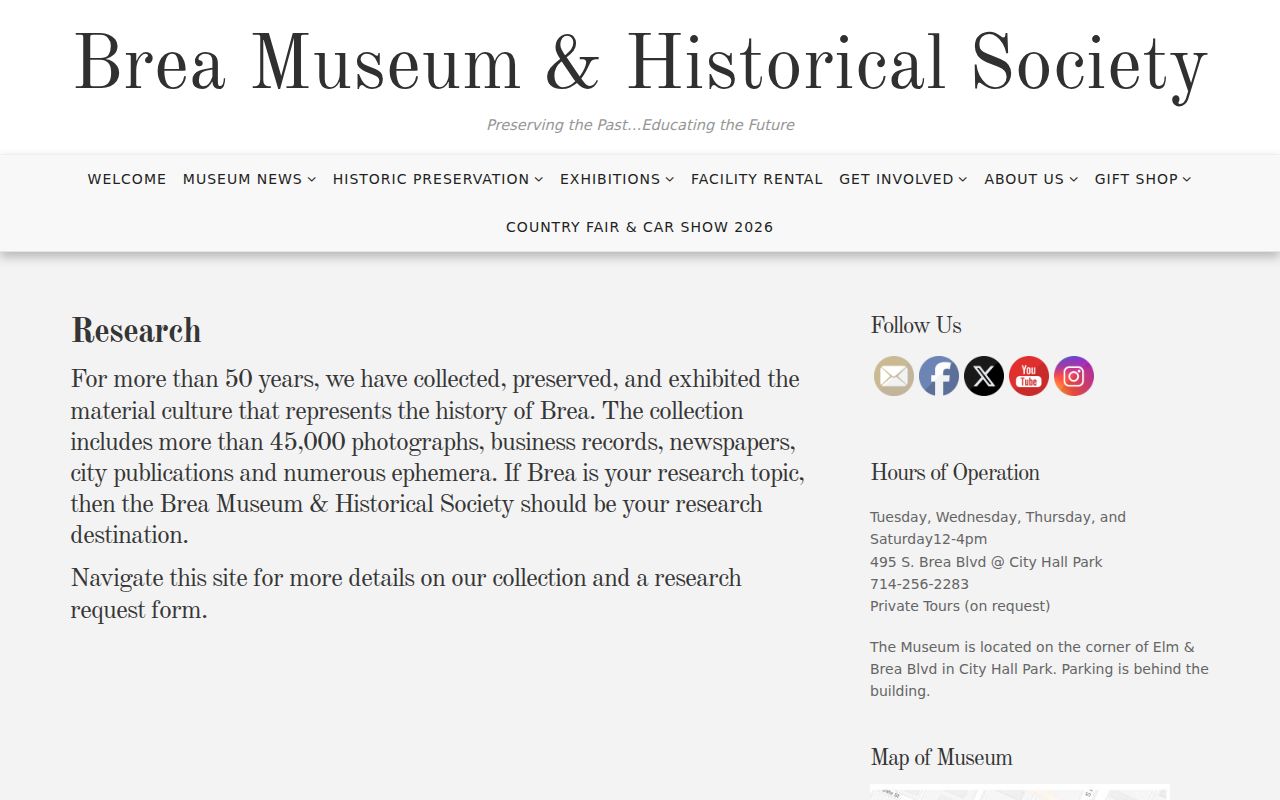
The research page image above points to the collection route rather than to a guaranteed digitized directory. Ask for the relevant finding aid, year, or subject file before relying on an archive lead.
Brea Library and the Local History Shelf
The Brea branch of Orange County Public Libraries is at 1 Civic Center Circle. Listed hours are Monday through Thursday 10 to 7 and Friday through Saturday 9 to 5. The branch offers public computers and countywide catalog and database access. Its public page does not itemize Brea city directories, obituary indexes, newspaper microfilm, Ancestry Library Edition, or HeritageQuest. Call (714) 671-1722 or email ocpl.brea@occr.ocgov.com to confirm a title, a year, a database, or a microfilm reader.
Ask staff to search subject terms such as Brea, Olinda, Orange County directories, school yearbooks, and local newspaper titles. A catalog hit is not always an open shelf item. A licensed database may require an in-branch session, and a historical volume may be held by another branch or archive. The librarian's answer is therefore part of the source record for a careful city directory project.
The library page linked above is a current service entry point, not a guarantee that a named directory is on the shelf. Confirm exact holdings before promising a year run.
How a Brea Directory Entry Reads
Read the page as the volume printed it. A typical Polk-style entry in this era may give a surname, given name or initial, spouse in parentheses, occupation or an employer abbreviation, and residence address. The letters can be more important than the prose. “h” often means householder or home, “r” may mean resident or roomer, and “wid” can mark a widow. A business entry can add a business address and phone. Confirm each symbol in the book's own key.
| Name | Indexed surname with given name or initial; spouse notation may appear. |
|---|---|
| Occupation | Work or business description, often abbreviated. |
| Residence | House number and street as printed in that edition. |
| Household mark | “h,” “r,” or another symbol whose meaning must be checked in the key. |
| Widow note | “wid” may identify a widow and can guide a family-history search. |
- Criss-cross directory
- A reverse section arranged by street and house number, if the volume contains one.
- Householder index
- A name list meant to point to the adult treated as the household contact.
- Abbreviation key
- The volume's own legend for occupation, residence, marital, or household marks.
- Index versus image
- An index points to a name or page. The scanned or physical page supplies the context.
These fields describe a named adult or householder. Children, boarders, and other household members are inconsistent or absent. A city directory is strongest when its date, address, and name are paired with a second record.
Brea's Directory Timeline
Brea's directory history follows the larger county and the city's shift from oil settlement to incorporated community. The following milestones are the ones the research supports, with gaps left visible.
- 1889: Orange County is created from Los Angeles County, creating a county boundary to test in older catalogs.
- 1917: Brea incorporates after oil-town development, so city records begin to sit beside county and community records.
- 1926: NARA's Orange County directory listing includes Brea.
- 1929: A second verified countywide directory year includes Brea and can be paired with the 1930 census.
- 1931: The NARA list also identifies an Orange County volume naming Brea.
- 1950: The latest currently public federal census year supplies household and tenure comparison for the historical trail.
No official source supplied a complete Brea publisher sequence, a last printed year, or a dated local criss-cross run. The absence is a catalog question, not evidence that no volume exists.
Tracing Family Through Brea City Directories
Use a Brea city directory as a dated set of snapshots. Start with the closest verified year, then move outward. Keep the exact spelling, initials, occupation, spouse notation, and address. Do not silently modernize a name or street. When a surname has two parts or a marriage may have changed it, search the printed form as well as the likely variant.
- Choose 1926, 1929, or 1931 based on the question, and read the title page and abbreviation key first.
- Search the alphabetical name section. Record every field, not just the street address.
- Use a street section only when the volume confirms that a reverse or criss-cross section is present.
- Compare the same name, spouse, occupation, and address across the verified years.
- Pair the 1929 volume with the 1930 census for ages, birthplace, household composition, and tenure.
- Test a disappearance with a deed, obituary, marriage, probate case, or nearby-city entry before deciding what happened.
A move can look like a death. A surname change can look like a disappearance. An unlisted boarder can look like an empty home. The correct conclusion comes from the pattern across sources, not from a blank line in one city directory.
Pair Brea Directory Years With the Census
The 1930 census is the natural companion to the 1929 city directory. The two sources were not collected on the same day and do not use the same definitions. The directory may emphasize a householder, while the census records the household present on its enumeration date. Compare the address, names, ages, birthplace, and tenure, then explain any conflict rather than forcing a match.
For an older Brea or Olinda family, extend the trail with the 1920 and 1940 census schedules, Museum photographs and newspapers, and the recorder's deed chain. Orange County's 1889 creation also matters. A pre-1889 record may be cataloged with Los Angeles County, a federal land record, a rancho record, or a successor archive.
Directory and census evidence show people at a period. A modern APN and deed chain show land. Combining them can build a house history, but the owner is not automatically the resident and the resident is not automatically every person in the household.
Search Olinda Alongside Brea
Brea's early oil landscape can place a family under an older community label. The Brea Museum's oil files, Olinda materials, city photographs, oral histories, and newspapers can explain why a directory entry uses a camp, company, or nearby place name. Search the surname with Brea, Olinda, Orange County, and the oil-company or street term printed in the original record.
The city Historic Preservation page adds register exhibits and Mills Act material for designated properties. Those files can connect a property with a builder, owner, architectural significance, or alteration history. They do not list every resident. Use the exhibit as a clue, then verify the person or land through the relevant custodian.
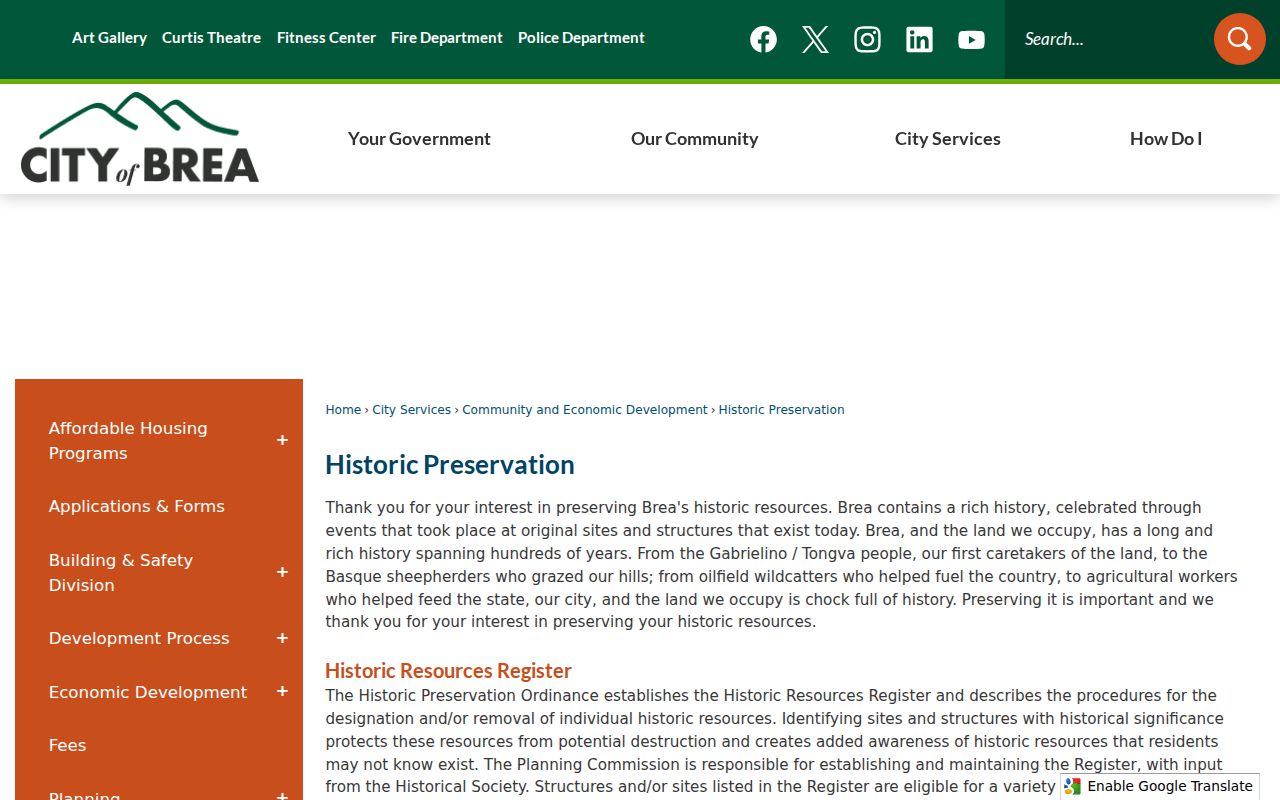
The Historic Preservation resource pictured above is most useful when paired with a directory page, permit chronology, assessor map, and deed copy. It gives a local story without turning a designation into a household roster.
When a Brea Name Disappears
A missing name in a later Brea city directory has several explanations. The person may have moved to Fullerton, La Habra, Anaheim, Olinda, or another nearby label. A spouse may have changed the indexed surname. The person may have died, entered a different household, or simply fallen outside the directory's coverage. Search the next volume, the reverse section, the census, newspapers, probate, and the Recorder index before choosing one explanation.
Probate can identify a decedent, personal representative, heirs, and a property connection in a public filing, subject to redaction or sealing. An obituary can supply relatives, former names, service place, and a date, but it should be checked against an official death record. A deed shows a transfer, not necessarily the date a family left the home.
Research habit. Photograph or transcribe the title page and abbreviation key before copying an entry. A short mark can change the meaning of the address or household clue.
What Remains to Verify in Brea Collections
The official research record leaves several useful questions open: the full year run in Brea and Fullerton, the publisher for each Orange County volume, the existence of a reverse section in each volume, exact local newspaper years, a branch obituary index, and a Brea-specific Sanborn sheet. The right response is a catalog request to NARA, Brea Museum, OC Public Libraries, the Library of Congress, or a regional special-collections finding aid.
The Brea meetings and agendas archive is another source to check when a name, address, or civic event is missing from a directory year.
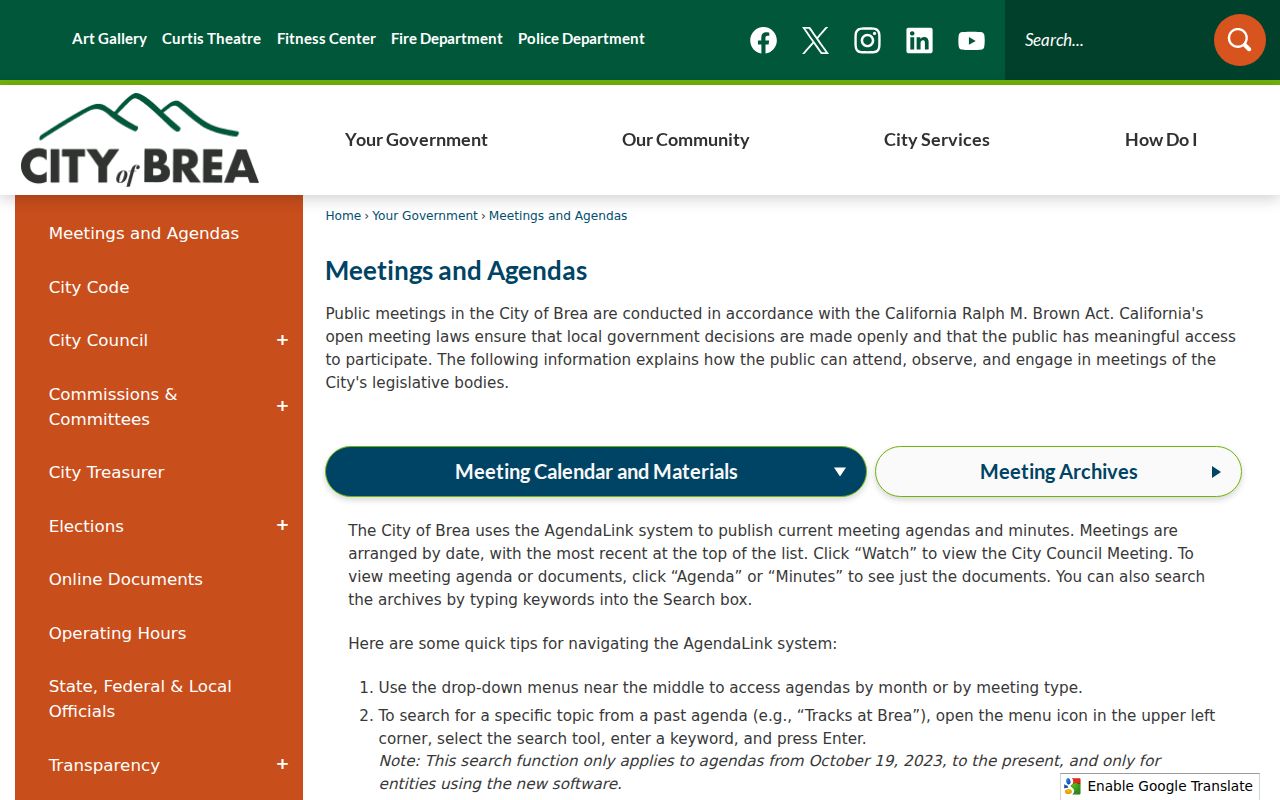
The Brea meetings archive is another place to test a name, address, or civic event when a directory year is missing. Its newer keyword search begins October 19, 2023; older agendas and minutes move to archived records, the Record Library, or a CPRA request.
Do not write a longer directory sequence from a generic genealogy reference. Keep the verified 1926, 1929, and 1931 Orange County inclusion visible, mark the other years as needing shelf verification, and note whether the item is a physical book, microfilm, digitized image, or collection-level description.
Once a historical directory supplies an address, the modern record path belongs to the parcel map, Assessor, permits, and deed chain. For a one-person present-day question, use the Brea resident lookup page rather than treating the historical shelf as a current directory.