
Brea Sources for Previous Residents
The best previous residents trail has an era plan. Current parcel records establish the land. Deeds establish recorded transfers. Permits establish work chronology. Directories and census schedules show named adults or households for specific years. The Brea Museum and historic-property files add photographs, newspapers, and local labels. Probate and obituaries can close a former person's trail. The table shows what each source can and cannot do.
| Source | Years It Covers | Where Held | What It Shows |
|---|---|---|---|
| Recorder index and copies | Modern online index; pre-1982 book/page reference break | Orange County Clerk-Recorder | Deed parties, dates, instruments, legal descriptions |
| Orange County directories including Brea | 1926, 1929, 1931 verified | NARA collection | Printed adult or householder name, occupation, address |
| Federal census | 1920-1950 currently public | NARA and partner databases | Household, ages, birthplace, and tenure for an enumeration date |
| City permits | Current system; historical start not published | Brea Building and Safety or CPRA | Work, applicants, contractors, inspections, and project chronology |
| Historic register and Museum | Designated properties and item dates vary | City Planning and Brea Museum | Property narratives, photos, newspapers, manuscripts, and local context |
| Sanborn fire maps | No Brea-specific year verified | LOC and California libraries | Footprint, use, and construction context if a sheet exists |
A prior owner is not automatically a prior resident. A directory entry is not a deed. Keep the source date, exact field, and uncertainty beside each name.
Start With Today's Brea Parcel
The current address is a locator, not the first historical fact. Enter the situs in the Orange County Assessor property-information gateway or the OC GIS viewer. Save the APN, tract or lot, legal description, map context, and any displayed assessment owner. Record the mailing address separately because a notice destination can be outside Brea. The APN may change after a split or merger, so the legal description is a useful parallel key.
Next, search the Brea Online Permit Center and the city's zoning map. A permit date can establish when work entered the system. A historic-register exhibit can identify an important property, builder, or alteration. These details help distinguish a house from another parcel with a similar number or name.
A parcel can survive a change in street label or house number through its tract, lot, legal description, and recorded chain. That is why the previous residents method starts with land rather than with a current people-search result.
- Chain of title
- The sequence of recorded ownership transfers for a parcel.
- Grantor
- The party conveying an interest in a recorded instrument.
- Grantee
- The party receiving an interest in that instrument.
- Legal description
- The tract, lot, or other land wording used to match a deed to the right parcel.
Tracing Past Owners Through Orange County Deeds
The Orange County Grantor-Grantee Index is the backbone of the ownership side of a previous residents search. It searches indexed party names, recording dates, and document categories. It does not provide a street browse or free public deed images. Search the owner as grantee, then inspect the likely conveyance instrument and match APN, tract, lot, and legal description before moving backward.
- Use the Brea address in the Assessor, GIS, zoning, and permit systems. Save APN, legal description, and any historic-site number.
- Search the current recorded owner as grantee. Filter by date and choose a conveyance instrument instead of a trust deed, reconveyance, or lien.
- Order the likely deed or obtain it at the Clerk-Recorder after saving the instrument reference. Compare its legal description and APN.
- Take the seller or grantor from that deed and search the same person as an earlier grantee.
- Repeat until the index or reference format reaches a gap. Use directory, census, Museum, obituary, and probate sources for people who occupied the land.
The recorder's instructions say staff do not perform a search for requesters. The researcher must identify the reference first. For copies, mail to 601 N. Ross Street, Santa Ana, with a self-addressed stamped envelope. The cited copy price is $1 per page plus $1 certification per document or map, subject to the current schedule.
The 1982 Brea Recorder Retrieval Break
Orange County's practical retrieval break is 1982. Pre-1982 copies require book, page, and instrument references when available. For 1982-forward documents, the recording year and a six-digit instrument number supply the working reference. This does not mean land recording began in 1982. It means the index and copy request use different handles on the older material.
The Orange County official-copy instructions explain the reference and mailing mechanics.
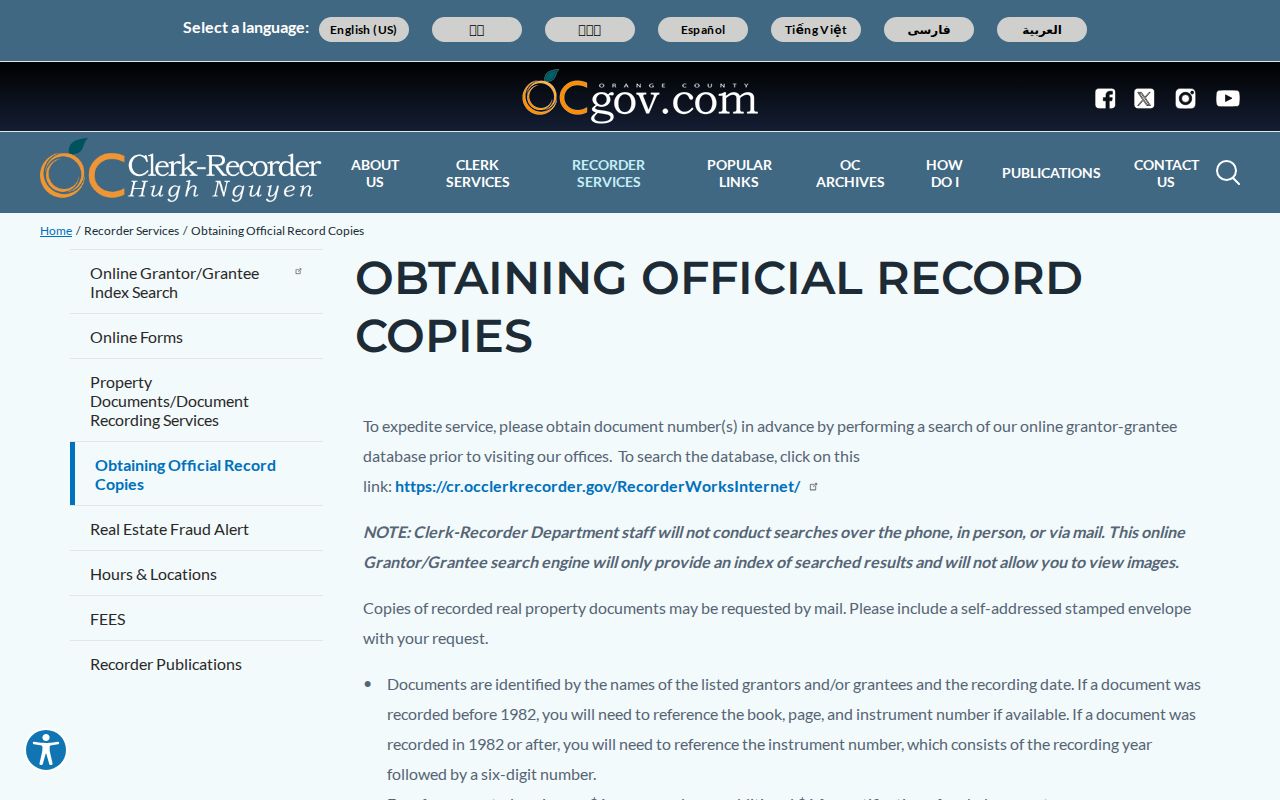
The official copy instructions shown above explain the reference and mailing mechanics. A free web result is still only an index. Save grantor, grantee, document type, recording date, instrument number, and any book or page before requesting a copy.
Continuity key. When an address string changes, match the deed's legal description, tract and lot, and APN before matching the person.
Date a Brea House Through Permits
Brea's Online Permit Center searches Building, Planning, Engineering, and Fire records around the clock. A public address search can add work descriptions, application dates, applicant or contractor names where public, project status, and inspection milestones. A free account exposes a user's own application history, invoices, receipts, and printable permits. The city has not published a complete historical start date, so do not assume that an old house has a complete online permit run.
The city's Historic Preservation page directs historic-property researchers to the Brea Historical Society and provides register and Mills Act material. Pair a designation exhibit with the Assessor map, deed copy, permit history, and Museum vertical files. Building plans have extra controls: confirm them through CPRA, view them by appointment, and obtain authorization from the current owner and each licensed designer before reproduction. Some tract files may contain only a model-home plan.
Permit evidence dates a project. It does not name every prior resident. Use it to frame the years that need directory, census, newspaper, or obituary work.
Brea Households in Directories and Census
The verified Orange County city directory years including Brea are 1926, 1929, and 1931. A printed entry may give surname, given name or initial, spouse, occupation, householder or resident mark, and address. A reverse section may show street order, but the official catalog did not verify that section or its publisher for every volume. Read the book's title page and key first.
- Choose the directory year closest to the event and transcribe the name, address, spouse, occupation, and abbreviation marks.
- Check the same street and nearby numbers only if a reverse section exists in that volume.
- Compare 1926, 1929, and 1931, then pair 1929 with the 1930 census.
- Use the census for household composition, ages, birthplace, and tenure on its enumeration date.
- Test a disappearance with a deed, obituary, marriage record, probate filing, or entry in a neighboring community.
The Brea city directory collections page keeps the shelf and entry method in one place. Those volumes serve here as the backward trail for a specific address.
Court Files for Past Residents
Orange County Superior Court records can add a probate, civil, family, or criminal event to the previous residents trail, but the case must be read in context. The court says records reach from 1889 to the present. Current case information is online; older indexes may remain at the justice center, and off-site files can take several days. A case role, filing date, and address in a permitted public filing can help distinguish two people with the same name.
The Orange County civil copy instructions describe the route from an index to an eligible file.
The civil copy request resource above is the correct route when an index is not the full record. For a criminal mail search, Form L-3009 asks for the name, date of birth, case or violation details, requested documents, payment, and a self-addressed stamped envelope.
The criminal record-search request page supplies the separate mail fallback.
The criminal request page pictured here is a mail fallback, not a reason to treat a party index as a complete history. Juvenile, adoption, sealed, and confidential material remains restricted.
Sanborn Maps and Brea House Context
Sanborn fire-insurance maps can show a building footprint, use, materials, and nearby structures when a sheet exists. The research did not verify a Brea-specific year in the Library of Congress catalog. Search the Library of Congress Sanborn collection by Brea, Olinda, Orange County, and predecessor place labels, then ask Brea Museum or a California library about local holdings.
A map is context, not a resident source. It can explain why a directory address, permit, or deed seems to describe the same building. Compare footprint, street alignment, tract or lot, and legal description. Do not claim a map exists for Brea until the sheet and year are confirmed.
The same rule applies to a street-renumbering theory. No official Brea-specific renumbering ordinance or year was found. Search city records and Museum files before converting an old number to a modern one.
Ask the Brea Museum About Historic Properties
The Brea Museum's archive and reference library hold photographs, newspapers, manuscripts, city documents, ephemera, and vertical files from the city's oil and civic history. The city recommends the Historical Society for archival information about historic properties. Ask for the property name, former owner, street, tract, Olinda or oil-camp label, and approximate era. That detail lets staff check a file without assuming that every person in an old photograph lived at the address.
A Museum lead can be paired with the Historic Register, Mills Act list, permit record, Assessor map, and Recorder deed. The combined chain can explain a house's change in use or a family's connection to a site. Oral history and anniversary material should remain identified as community evidence until an official record supports the date or identity.
Close a Previous Resident Trail Carefully
A former resident's trail may end at a later deed, a directory disappearance, a death record, an obituary, or a probate case. Those endpoints answer different questions. A death record can confirm an event. An obituary can add relatives and community detail. Probate can identify a decedent, representatives, and heirs in a public filing. A deed can show an estate transfer. None should be used to fill a missing field by guesswork.
When the source goes offline, use the Brea City Clerk's Record Library and CPRA form, the county Recorder copy process, Brea Library catalog help, NARA, or the Museum. The requester should name an existing record, date range, and likely custodian. CPRA does not require the city to create a new list of previous residents.
House-history boundary. A property history can support genealogy and preservation research. It does not authorize unwanted contact, surveillance, or a claim that a former owner was the only person who lived in the house.
For current parcel work, the Brea street directory page starts with address and APN. For household members and one-person identity questions, stop and use the custodian-specific route.